12 Universal Design Principles
TL;DR
I am still writing this essay. It will be updated as I write it. I quit social media to reclaim my time and noticed how addictive technology has become, capturing our attention through infinite scrolls and algorithmic rewards. AI introduces new challenges: it can aid those who already have skills, but also encourages shortcuts that bypass learning. Society increasingly treats technology as consumption rather than a tool for creation, risking a generation unprepared for a fast, complex world.



Some of the topics I will cover here are:
- How frictionless interaction shapes our behaviour.
- The use of AI-generated content on social media.
- Echo chambers, the Dunning-Kruger effect, and why it's good to be called stupid once in a while.
- The use of AI as a shortcut that brings you nowhere.
- Critical thinking.
- Bring value in AI era.
- The role of design when there are no technical barriers.
- The tendency of humans and animals to reduce effort, and how that could be harming us.
Introduction
At the beginning of this year, I decided to completely disconnect from social media: somehow, what should have been limited to recreational use was taking up a significant portion of my free time, leaving me feeling exhausted and, even worse, making me lose track of time. Like with any addiction, whenever I looked up, I was filled with guilt. Not for being unproductive, but for not having spent my time better on things I actually care about—reading, cooking, or watching a movie. Over time, I’ve managed to moderate my use, though the relationship remains, at times, turbulent.
I suppose this problem doesn’t affect everyone equally, but it’s almost impossible to ignore. Young people are embracing analog cameras. Nokia phones are coming back into style. More and more people are listening to music with wired headphones on an MP3 player, and many institutions advocate for controlling and limiting social media use among minors (and I suspect this trend will only grow). If it’s not you and Instagram, it’s your children and Fortnite, your parents and Facebook, or your partner and Candy Crush. By leveraging tools like intermittent random rewards and intelligent algorithms capable of personalizing the content you see, we’ve developed technology that captures—if not outright kidnaps—our attention. At the same time, infinite scrolling is an interaction designed to minimize friction, letting you move effortlessly from something you don’t like to something you do, for an unlimited amount of time. David Foster Wallace said in a 2003 interview that he couldn’t have a TV at home. He argued that, thanks to the remote control, it was irresistible to lie on the couch and channel-surf. He didn’t think this was wrong per se, but television offered an option too tempting compared to others, like reading, which demanded greater effort and attention. A lot has changed in the last 20 years, but I wonder what he would have thought of mobile phones and social media.
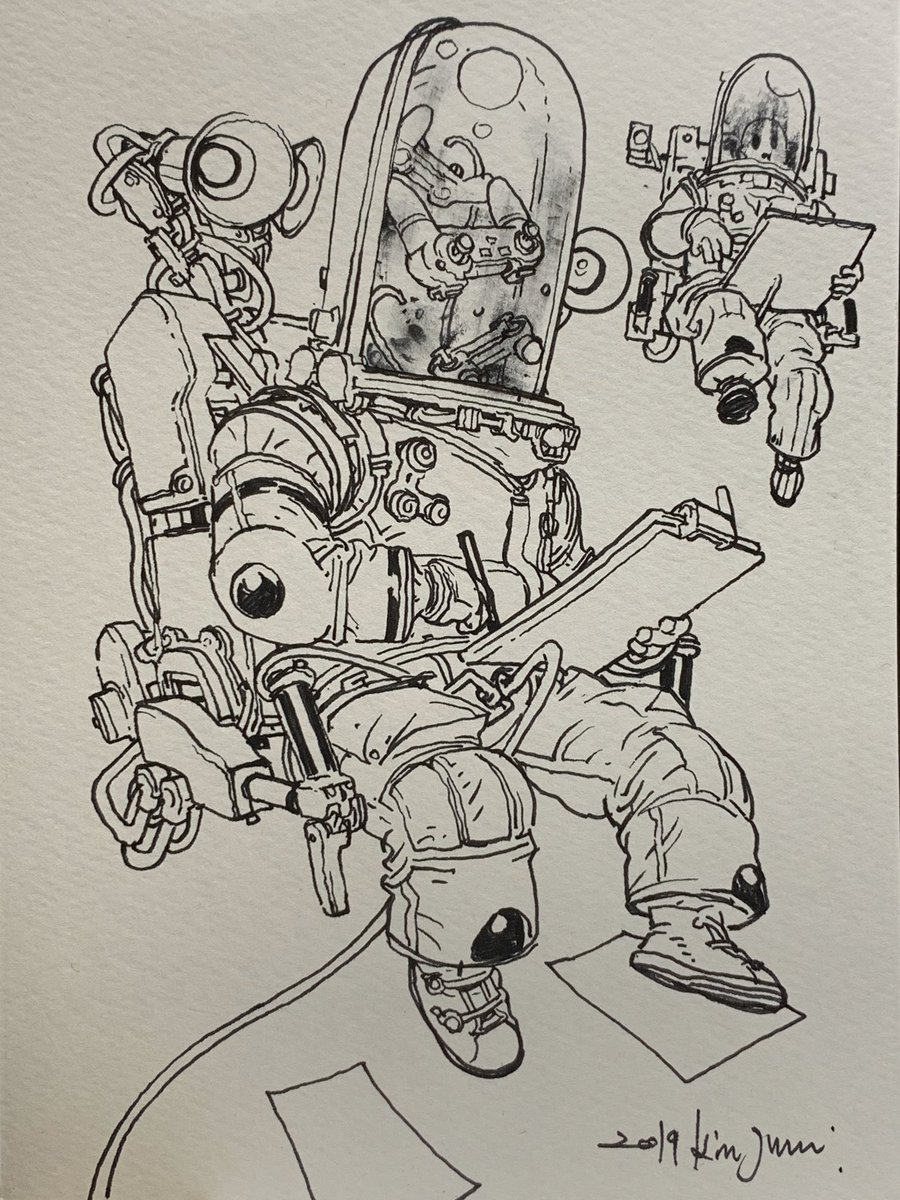
Draw by Kim Jung-Gi.
The rise of artificial intelligence has brought new debates to the table that go beyond its utility or the echo chambers it creates. Until now, all mechanization and automation had been physical, but where does that leave a technology that allows intellectual and creative tasks to be executed? What will happen when studying a discipline ceases to be a personal incentive? It’s inevitable that a technology that significantly reduces friction in completing a task compared to its predecessor will eventually be adopted en masse. It happened with the domestication of draft animals in agriculture, with the steam engine in industry, and it will happen with AI, even if we don’t yet know exactly in which sectors.
Meanwhile, some people don’t regulate their use, and others reject it outright. As always, education and moderation are easy prescriptions to recommend but difficult to put into practice. For someone who has developed their skills through practice and study, using AI to summarize content doesn’t seem unreasonable. But for someone still learning, asking ChatGPT to write an essay on a topic they haven’t even studied is problematic. In my view, the problem isn’t the tool itself, but our inability to convey the importance of developing your skills and acquiring knowledge. Not to mention the zero personal value it provides, and the contribution—or lack thereof—to others.
To conclude this introduction, I’d like to add that I’m noticing a growing trend of perceiving technology as an object of consumption rather than as a tool for creation. Our response has been to push young people away from not just the former, but from both meanings. The result will be a lack of preparation and skills to navigate a fast-paced, ever-changing world without technical barriers. We have a steam engine for the brain in our hands, and instead of using it to enhance our abilities and satisfy our curiosity, we spend hours consuming content that dulls and numbs us, and now, with artificial intelligence, taking unproductive shortcuts that lead nowhere.
12 Universal Design Principles
TL;DR
I am still writing this essay. It will be updated as I write it. I quit social media to reclaim my time and noticed how addictive technology has become, capturing our attention through infinite scrolls and algorithmic rewards. AI introduces new challenges: it can aid those who already have skills, but also encourages shortcuts that bypass learning. Society increasingly treats technology as consumption rather than a tool for creation, risking a generation unprepared for a fast, complex world.
Some of the topics I will cover here are:
- How frictionless interaction shapes our behaviour.
- The use of AI-generated content on social media.
- Echo chambers, the Dunning-Kruger effect, and why it's good to be called stupid once in a while.
- The use of AI as a shortcut that brings you nowhere.
- Critical thinking.
- Bring value in AI era.
- The role of design when there are no technical barriers.
- The tendency of humans and animals to reduce effort, and how that could be harming us.
Introduction
At the beginning of this year, I decided to completely disconnect from social media: somehow, what should have been limited to recreational use was taking up a significant portion of my free time, leaving me feeling exhausted and, even worse, making me lose track of time. Like with any addiction, whenever I looked up, I was filled with guilt. Not for being unproductive, but for not having spent my time better on things I actually care about—reading, cooking, or watching a movie. Over time, I’ve managed to moderate my use, though the relationship remains, at times, turbulent.
I suppose this problem doesn’t affect everyone equally, but it’s almost impossible to ignore. Young people are embracing analog cameras. Nokia phones are coming back into style. More and more people are listening to music with wired headphones on an MP3 player, and many institutions advocate for controlling and limiting social media use among minors (and I suspect this trend will only grow). If it’s not you and Instagram, it’s your children and Fortnite, your parents and Facebook, or your partner and Candy Crush. By leveraging tools like intermittent random rewards and intelligent algorithms capable of personalizing the content you see, we’ve developed technology that captures—if not outright kidnaps—our attention. At the same time, infinite scrolling is an interaction designed to minimize friction, letting you move effortlessly from something you don’t like to something you do, for an unlimited amount of time. David Foster Wallace said in a 2003 interview that he couldn’t have a TV at home. He argued that, thanks to the remote control, it was irresistible to lie on the couch and channel-surf. He didn’t think this was wrong per se, but television offered an option too tempting compared to others, like reading, which demanded greater effort and attention. A lot has changed in the last 20 years, but I wonder what he would have thought of mobile phones and social media.
Draw by Kim Jung-Gi.
The rise of artificial intelligence has brought new debates to the table that go beyond its utility or the echo chambers it creates. Until now, all mechanization and automation had been physical, but where does that leave a technology that allows intellectual and creative tasks to be executed? What will happen when studying a discipline ceases to be a personal incentive? It’s inevitable that a technology that significantly reduces friction in completing a task compared to its predecessor will eventually be adopted en masse. It happened with the domestication of draft animals in agriculture, with the steam engine in industry, and it will happen with AI, even if we don’t yet know exactly in which sectors.
Meanwhile, some people don’t regulate their use, and others reject it outright. As always, education and moderation are easy prescriptions to recommend but difficult to put into practice. For someone who has developed their skills through practice and study, using AI to summarize content doesn’t seem unreasonable. But for someone still learning, asking ChatGPT to write an essay on a topic they haven’t even studied is problematic. In my view, the problem isn’t the tool itself, but our inability to convey the importance of developing your skills and acquiring knowledge. Not to mention the zero personal value it provides, and the contribution—or lack thereof—to others.
To conclude this introduction, I’d like to add that I’m noticing a growing trend of perceiving technology as an object of consumption rather than as a tool for creation. Our response has been to push young people away from not just the former, but from both meanings. The result will be a lack of preparation and skills to navigate a fast-paced, ever-changing world without technical barriers. We have a steam engine for the brain in our hands, and instead of using it to enhance our abilities and satisfy our curiosity, we spend hours consuming content that dulls and numbs us, and now, with artificial intelligence, taking unproductive shortcuts that lead nowhere.
So easy it's almost scary
TL;DR
I am still writing this essay. It will be updated as I write it. I quit social media to reclaim my time and noticed how addictive technology has become, capturing our attention through infinite scrolls and algorithmic rewards. AI introduces new challenges: it can aid those who already have skills, but also encourages shortcuts that bypass learning. Society increasingly treats technology as consumption rather than a tool for creation, risking a generation unprepared for a fast, complex world.
Some of the topics I will cover here are:
- How frictionless interaction shapes our behaviour.
- The use of AI-generated content on social media.
- Echo chambers, the Dunning-Kruger effect, and why it's good to be called stupid once in a while.
- The use of AI as a shortcut that brings you nowhere.
- Critical thinking.
- Bring value in AI era.
- The role of design when there are no technical barriers.
- The tendency of humans and animals to reduce effort, and how that could be harming us.
Introduction
At the beginning of this year, I decided to completely disconnect from social media: somehow, what should have been limited to recreational use was taking up a significant portion of my free time, leaving me feeling exhausted and, even worse, making me lose track of time. Like with any addiction, whenever I looked up, I was filled with guilt. Not for being unproductive, but for not having spent my time better on things I actually care about—reading, cooking, or watching a movie. Over time, I’ve managed to moderate my use, though the relationship remains, at times, turbulent.
I suppose this problem doesn’t affect everyone equally, but it’s almost impossible to ignore. Young people are embracing analog cameras. Nokia phones are coming back into style. More and more people are listening to music with wired headphones on an MP3 player, and many institutions advocate for controlling and limiting social media use among minors (and I suspect this trend will only grow). If it’s not you and Instagram, it’s your children and Fortnite, your parents and Facebook, or your partner and Candy Crush. By leveraging tools like intermittent random rewards and intelligent algorithms capable of personalizing the content you see, we’ve developed technology that captures—if not outright kidnaps—our attention. At the same time, infinite scrolling is an interaction designed to minimize friction, letting you move effortlessly from something you don’t like to something you do, for an unlimited amount of time. David Foster Wallace said in a 2003 interview that he couldn’t have a TV at home. He argued that, thanks to the remote control, it was irresistible to lie on the couch and channel-surf. He didn’t think this was wrong per se, but television offered an option too tempting compared to others, like reading, which demanded greater effort and attention. A lot has changed in the last 20 years, but I wonder what he would have thought of mobile phones and social media.
Draw by Kim Jung-Gi.
The rise of artificial intelligence has brought new debates to the table that go beyond its utility or the echo chambers it creates. Until now, all mechanization and automation had been physical, but where does that leave a technology that allows intellectual and creative tasks to be executed? What will happen when studying a discipline ceases to be a personal incentive? It’s inevitable that a technology that significantly reduces friction in completing a task compared to its predecessor will eventually be adopted en masse. It happened with the domestication of draft animals in agriculture, with the steam engine in industry, and it will happen with AI, even if we don’t yet know exactly in which sectors.
Meanwhile, some people don’t regulate their use, and others reject it outright. As always, education and moderation are easy prescriptions to recommend but difficult to put into practice. For someone who has developed their skills through practice and study, using AI to summarize content doesn’t seem unreasonable. But for someone still learning, asking ChatGPT to write an essay on a topic they haven’t even studied is problematic. In my view, the problem isn’t the tool itself, but our inability to convey the importance of developing your skills and acquiring knowledge. Not to mention the zero personal value it provides, and the contribution—or lack thereof—to others.
To conclude this introduction, I’d like to add that I’m noticing a growing trend of perceiving technology as an object of consumption rather than as a tool for creation. Our response has been to push young people away from not just the former, but from both meanings. The result will be a lack of preparation and skills to navigate a fast-paced, ever-changing world without technical barriers. We have a steam engine for the brain in our hands, and instead of using it to enhance our abilities and satisfy our curiosity, we spend hours consuming content that dulls and numbs us, and now, with artificial intelligence, taking unproductive shortcuts that lead nowhere.